Black-hole ringing, tested on two real events
A black hole formed in a merger rings down like a struck bell. Its tones are quasinormal modes (QNMs: oscillations that decay as they radiate), and the overtones are the faster-decaying tones above the fundamental.
The modes
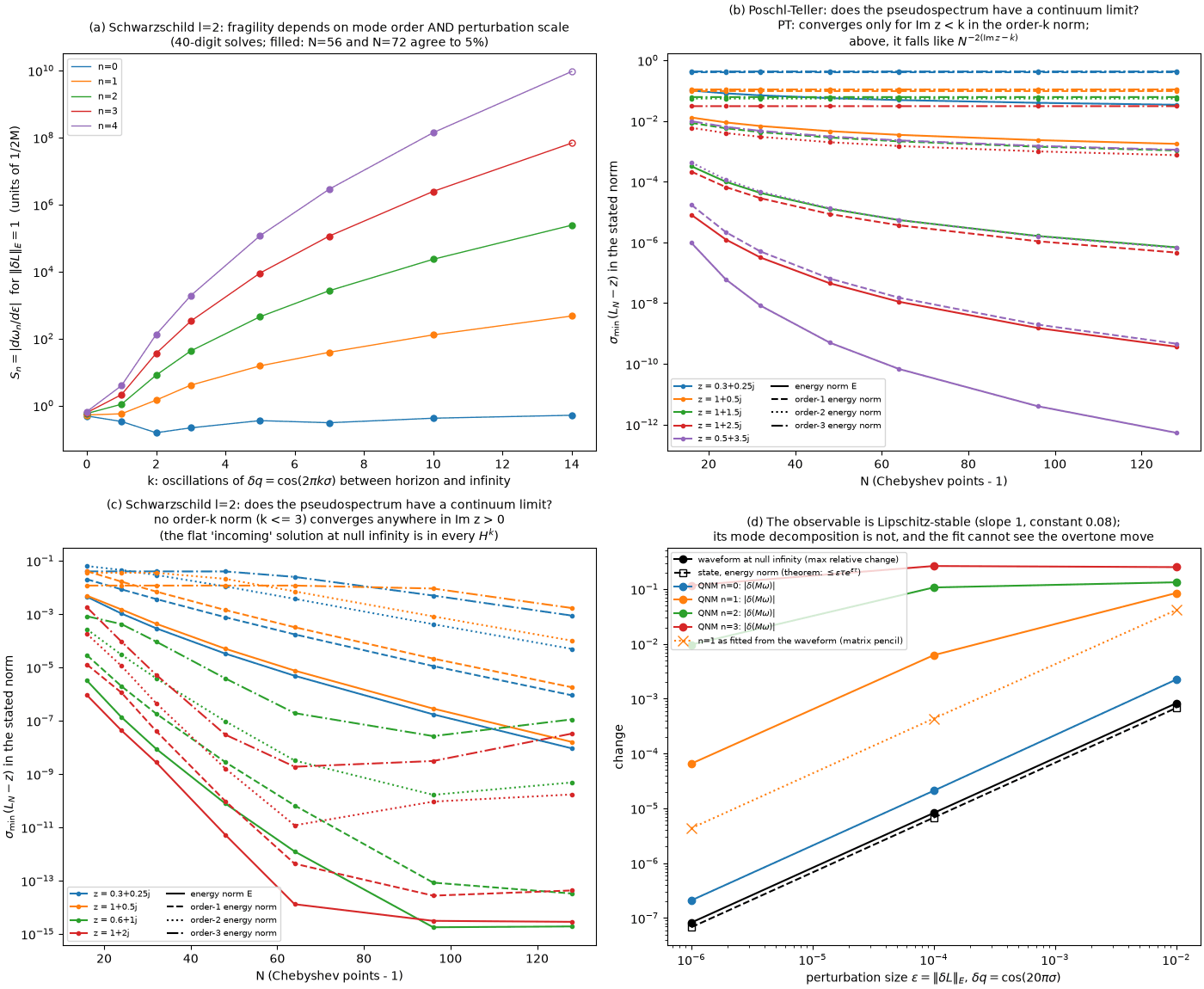
- QNMs computed three independent ways agree to 6e-14.verified · known
- Overtones are fragile under sharp perturbations of the black hole.verified · known
GW150914, the first detected merger
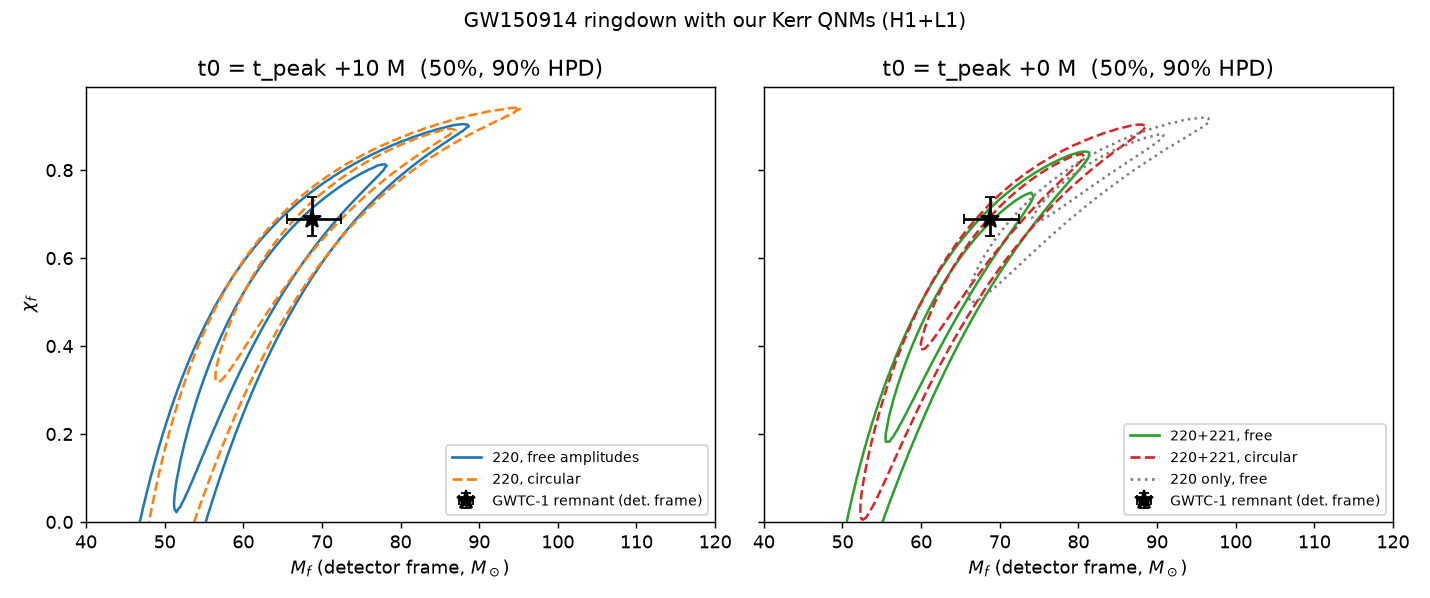
- The lab’s own QNMs recover LIGO’s value for the final black hole: mass 60.7 solar masses [50.5, 78.4], spin 0.46. Reproduced from the repository.verified · known
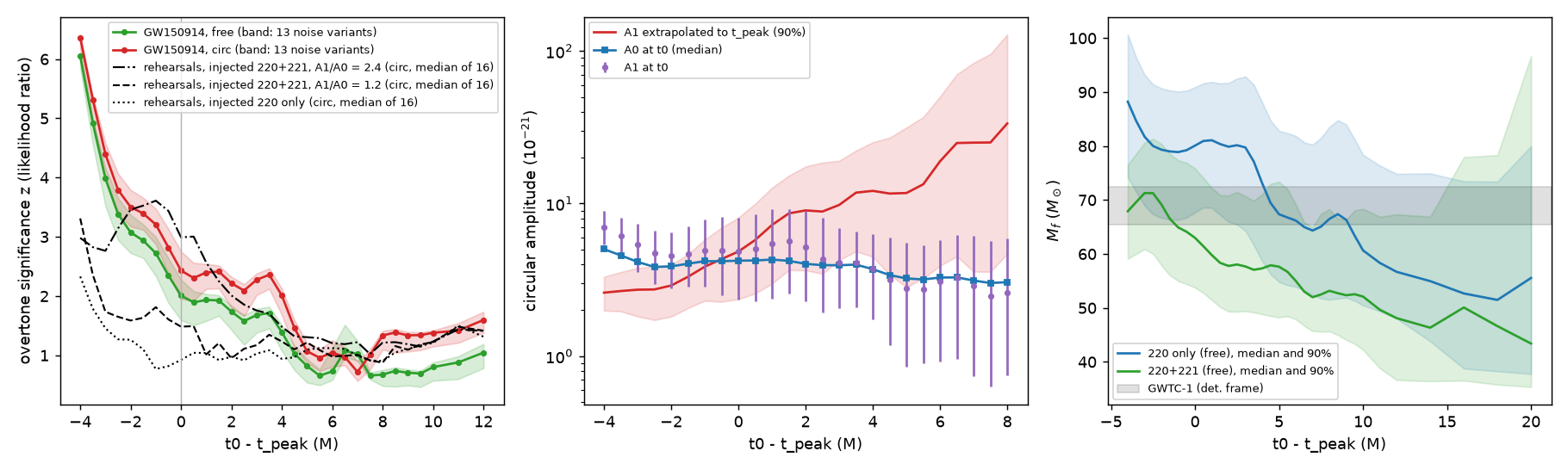
- The first overtone is about 2σ (two standard deviations) once calibrated, and its strength depends on the chosen start time.
GW250114, the loudest event so far
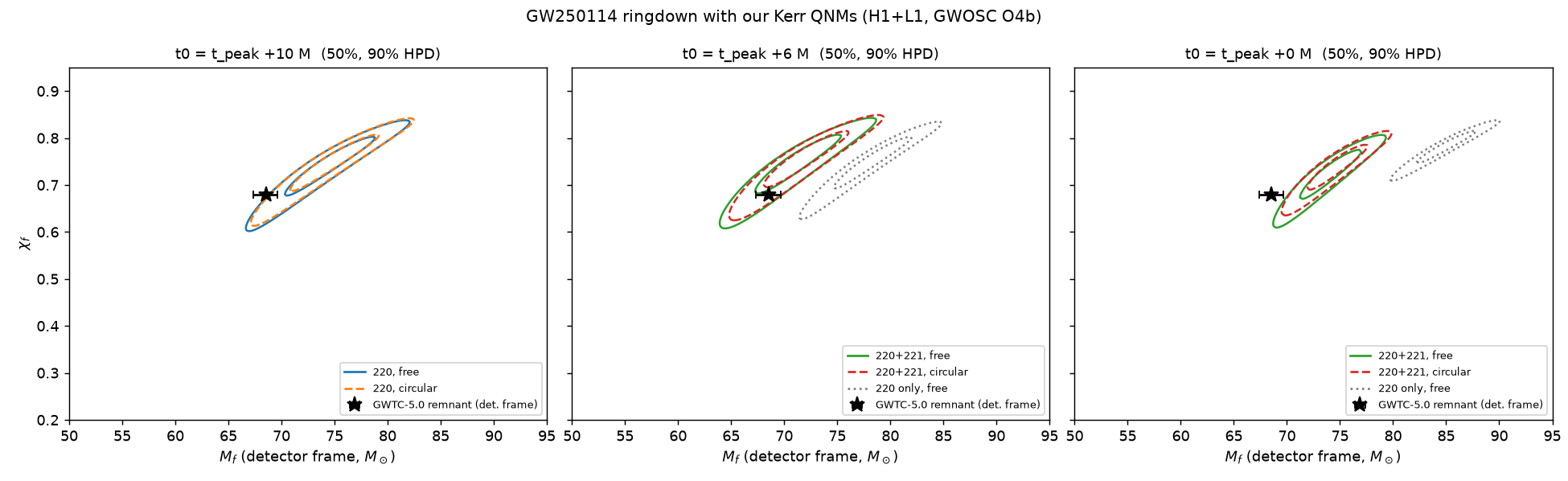
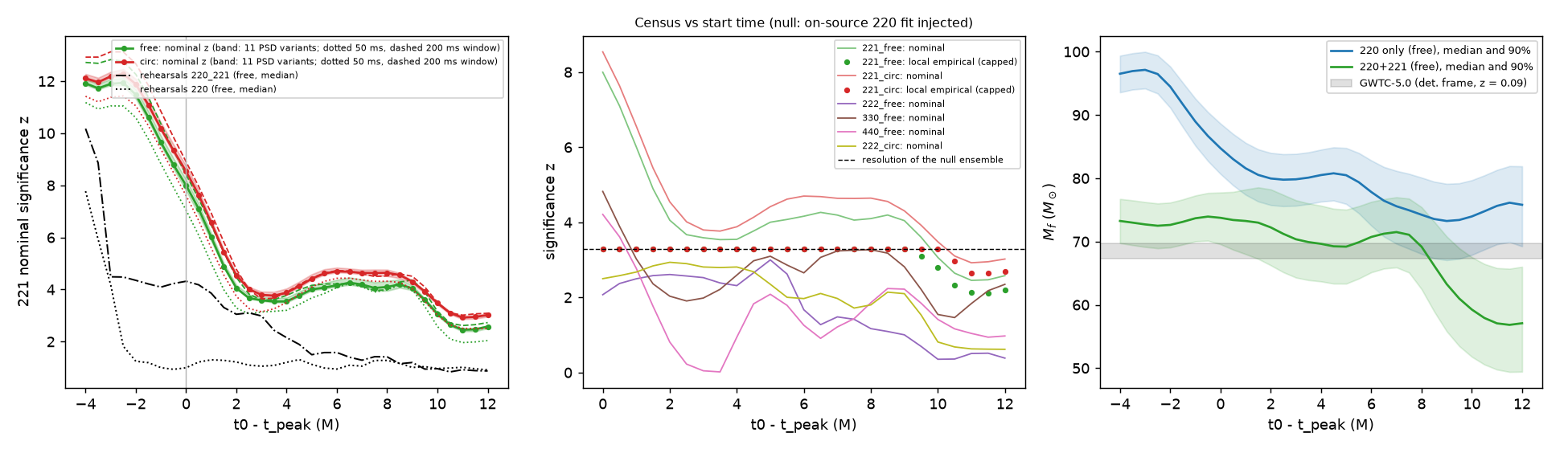
- The primary prediction failed narrowly. Starting the fit 10 M after the peak (M is the black hole’s mass in units of time), LIGO’s final mass and spin sit at the 0.944 level of the fit’s highest-posterior-density region (the smallest region holding that share of the fit’s probability). From 14 M they are consistent.
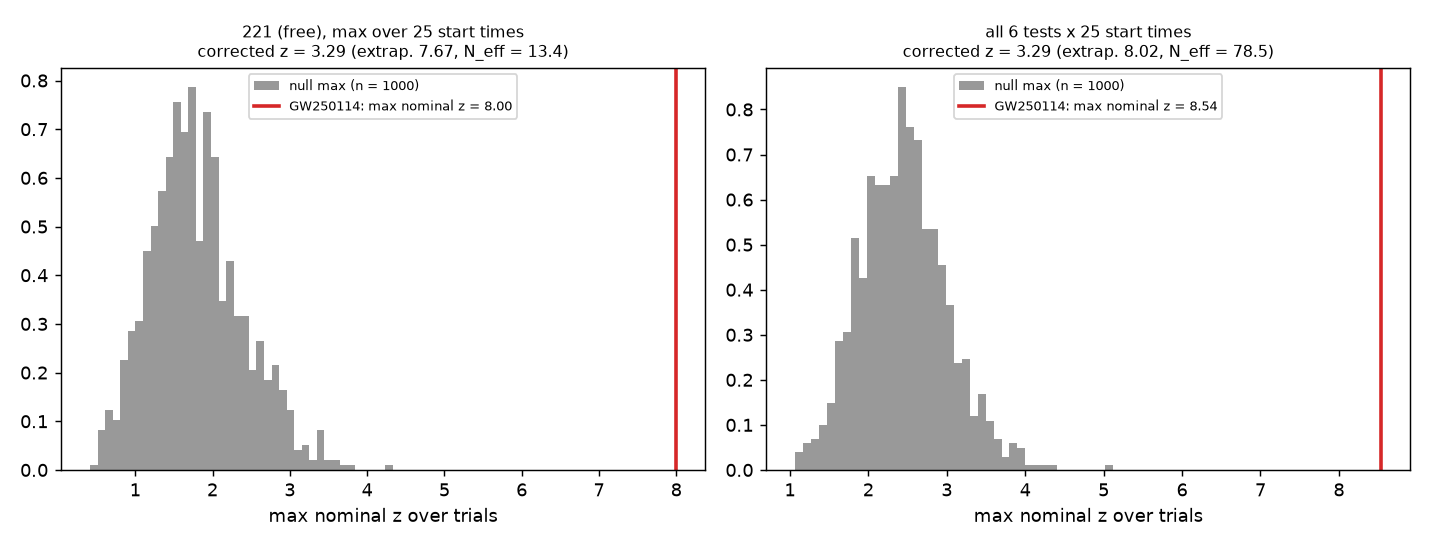
- A census of overtones, corrected for the number of fits tried: the 221 overtone survives the correction, at 3.1 to 3.8σ for start times of 6 to 12 M.
- A possible plateau of extra signal between 5 and 9 M. The leading candidate is a quadratic mode (one produced by the nonlinearity of gravity), but this is unresolved.
- Area theorem: the final horizon area is 1.78 times the initial total (Hawking’s area theorem requires it to grow).
- The light-ring estimate is reported only as a comparison with De Simone et al. (2026).
Correction
- An earlier comparison, “smooth 1.06 against sharp 11.7”, set two different statistics against each other and is withdrawn. What holds up as a sign that a one-mode model is wrong: a fit with a single mode becomes safe only from about 12 M after the peak.
Lab records: H-0006, H-0018; ledger/notes/t2-*; understanding/03.
Tags: confidence (proved, verified, observed, suggestive, pending) and novelty (known, narrow, ours), defined on the overview.