The tools on real systems: the lab’s own agents and a quantum computer
Two tests outside simulation: the lab audited its own record with fresh AI auditors, and ran an audit protocol on an IBM quantum processor.
Auditing the lab’s own record (H-0012)
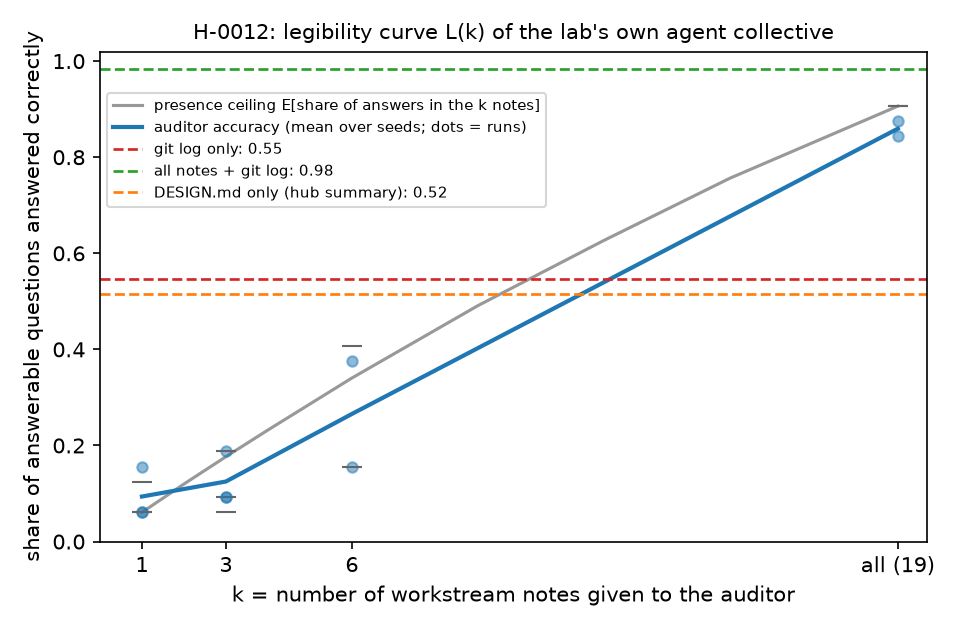
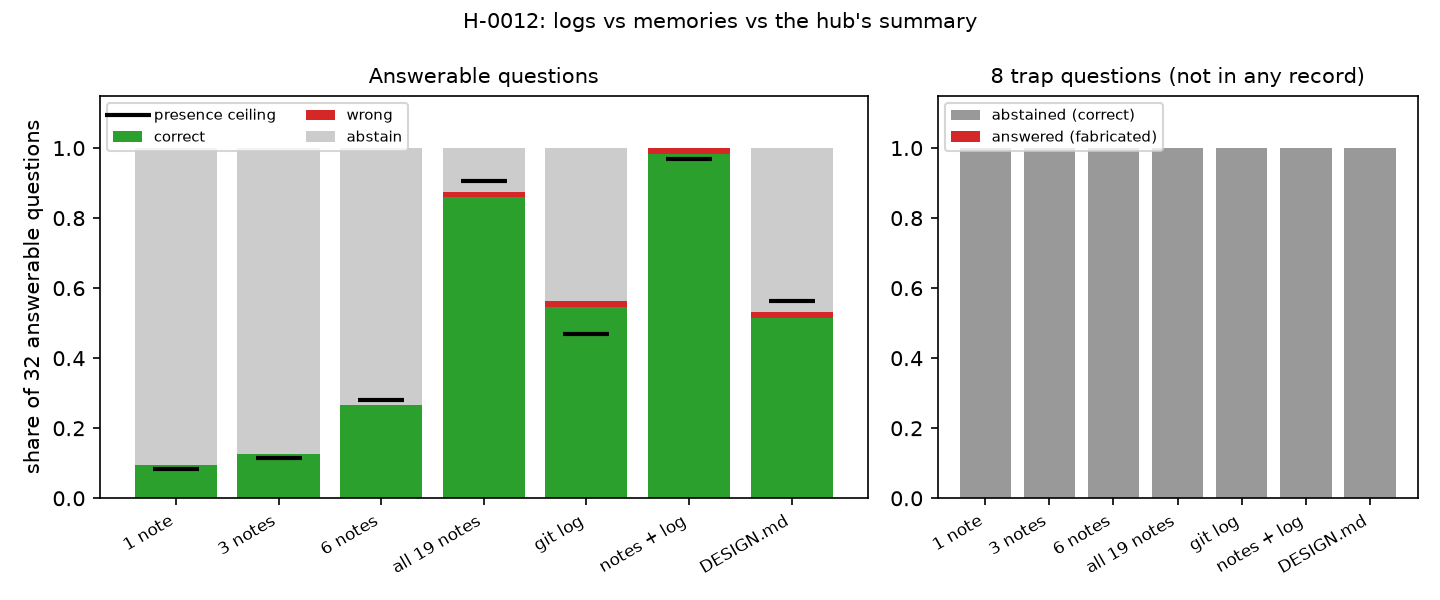
- Fresh AI auditors read k of the lab’s 19 notes and answered questions about the work. Accuracy rose linearly with k, from 0.09 to 0.86, and the notes plus the git log reached 0.98, with 0 fabricated answers on 128 trap questions. Accuracy is about 0.93 times presence (whether the answer was in what the auditor read): what limits legibility here is what was written, not how well it is read. Small n.observed
- Logs beat memories, but only for readers with bounded effort: logs keep records from before the information was mixed away. In Shannon’s terms memories hold at least as much.
Auditing the logs (H-0017)
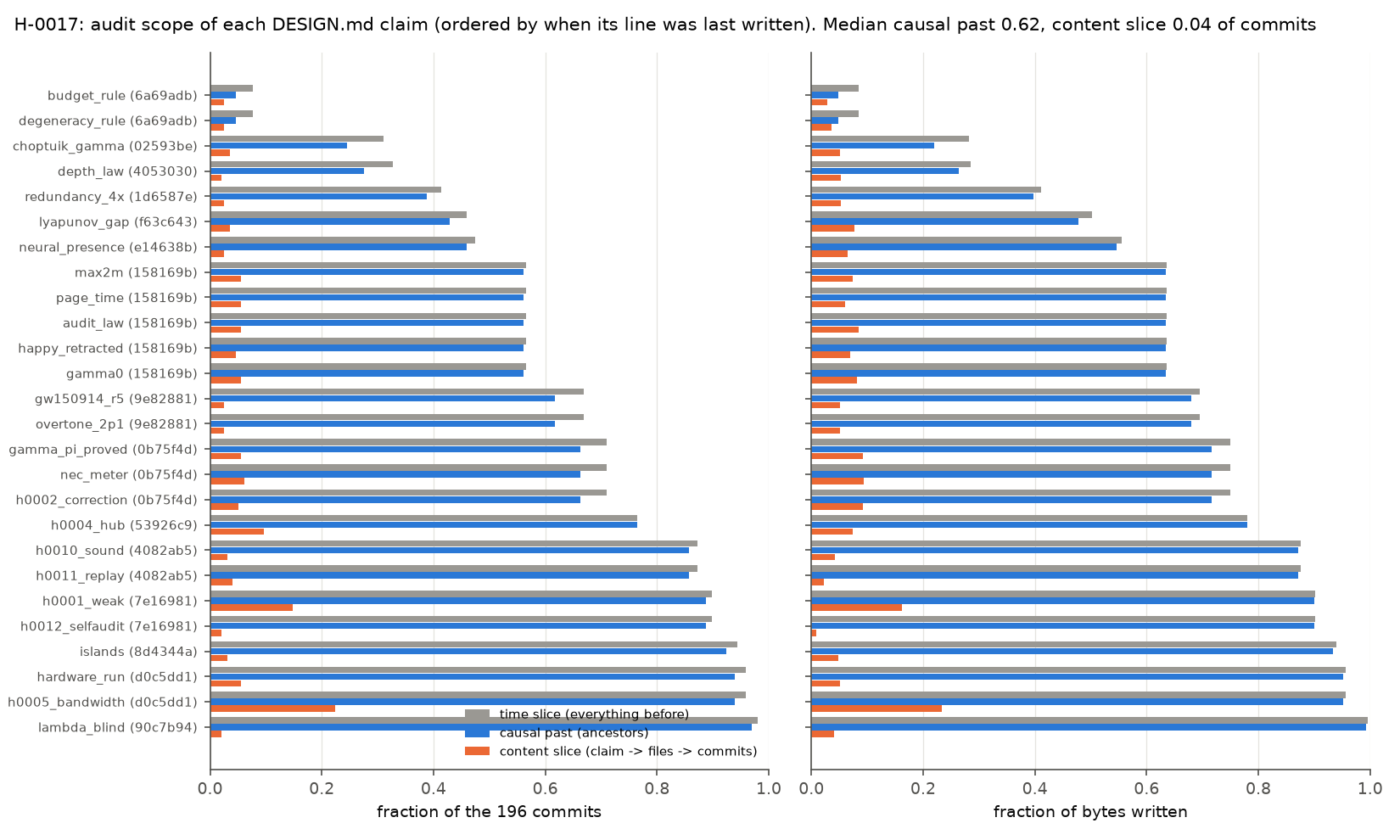
- A hub agent is a provenance horizon: slicing the record by cause returns nearly everything, while slicing by content returns a part 16 times smaller. Copies make corrections hard (ρ = 0.97); the audit found and fixed 14 stale statements.
IBM run 1 (ibm_fez, 83 seconds of quantum-processor time)
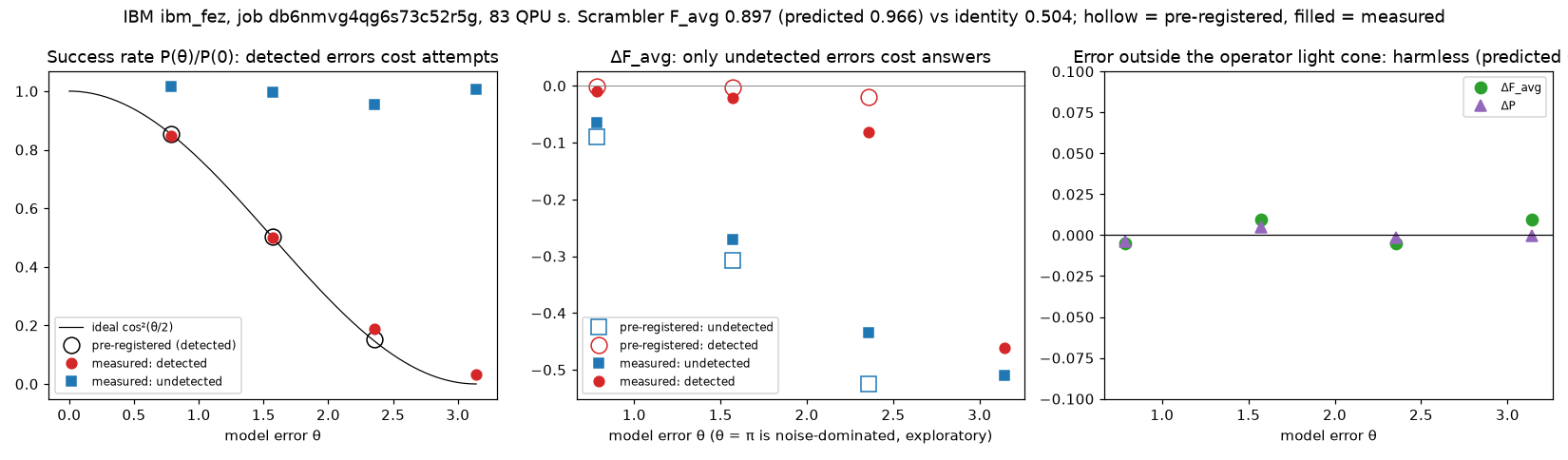
- Detected errors in the auditor’s model cost success rate (0.85, 0.50 and 0.19 against predicted 0.86, 0.50 and 0.15) while the answers stayed right. Undetected errors cost fidelity. Errors outside the light cone changed nothing (±0.01).
- Corrected: the two-qubit (D12) rows cannot show that the circuit scrambles, because a SWAP gate passes them. The single-qubit rows (fidelity 0.81 and 0.84, both above 2/3) rule out a SWAP at more than 40σ, for Clifford scramblers under a model that trusts the device. Prediction P2 missed because of coherent errors in the identity circuit.
- IBM round 2: pending, held back for a redesign before any data.pending
- The audit-rate transition (H-0014): pending. The ring value p_c = 0.1598 is reproduced.pending
Lab records: H-0007, H-0012, H-0016, H-0017; understanding/08 and 11.
Tags: confidence (proved, verified, observed, suggestive, pending) and novelty (known, narrow, ours), defined on the overview.