Collapse, Hawking radiation, analog horizons and islands
Four parts of black-hole physics the lab rebuilt from scratch, checked against published values before using them as tools.
Critical collapse
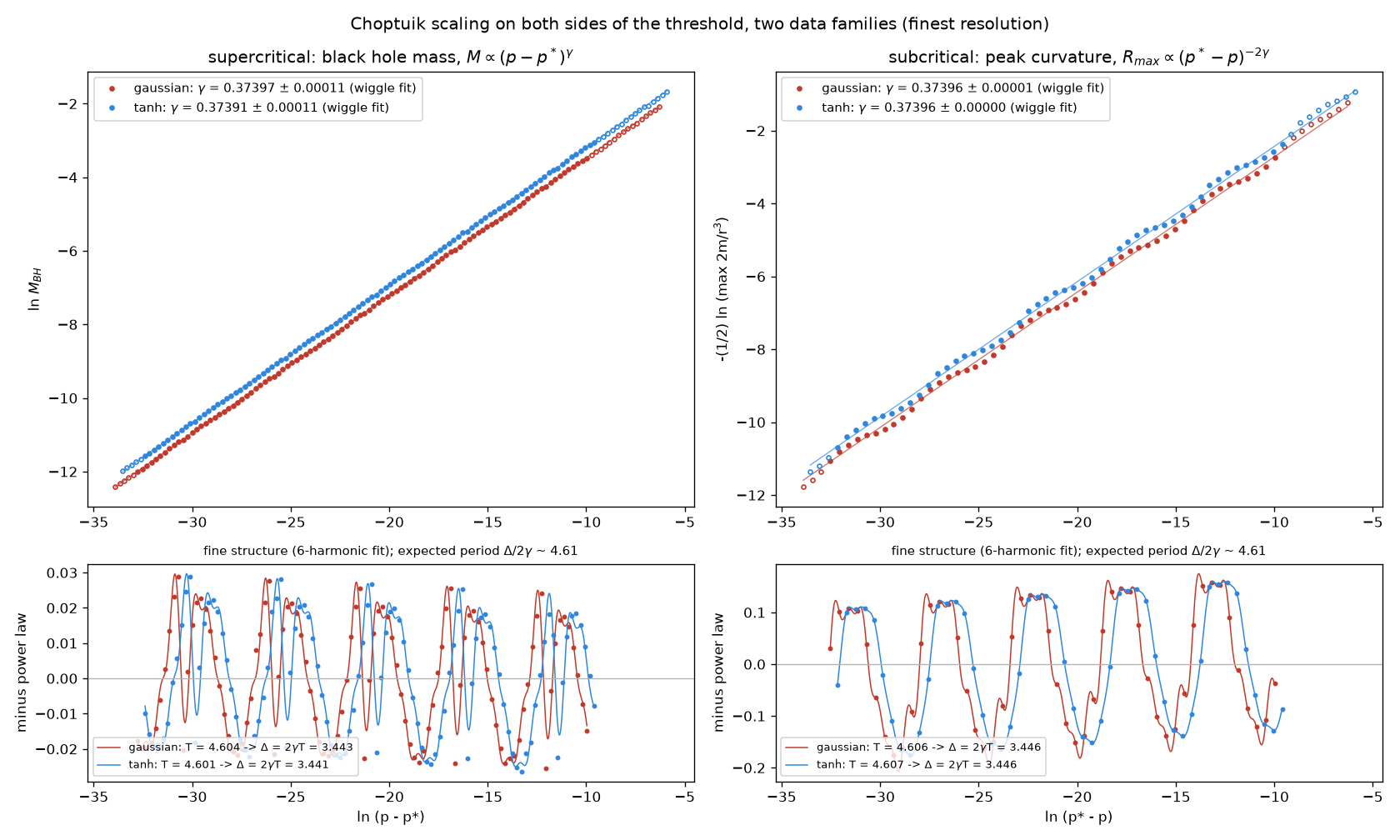
- At the threshold where collapsing matter just forms a black hole (Choptuik’s critical collapse), the lab reproduces the scaling exponent γ = 0.37396 ± 0.00005 and the echoing period Δ = 3.4453 ± 0.0003, universal to 3e-6.verified · known
- The maximum of 2m/r on the critical solution is 0.53284, its first explicit value.verified · narrow
Hawking radiation
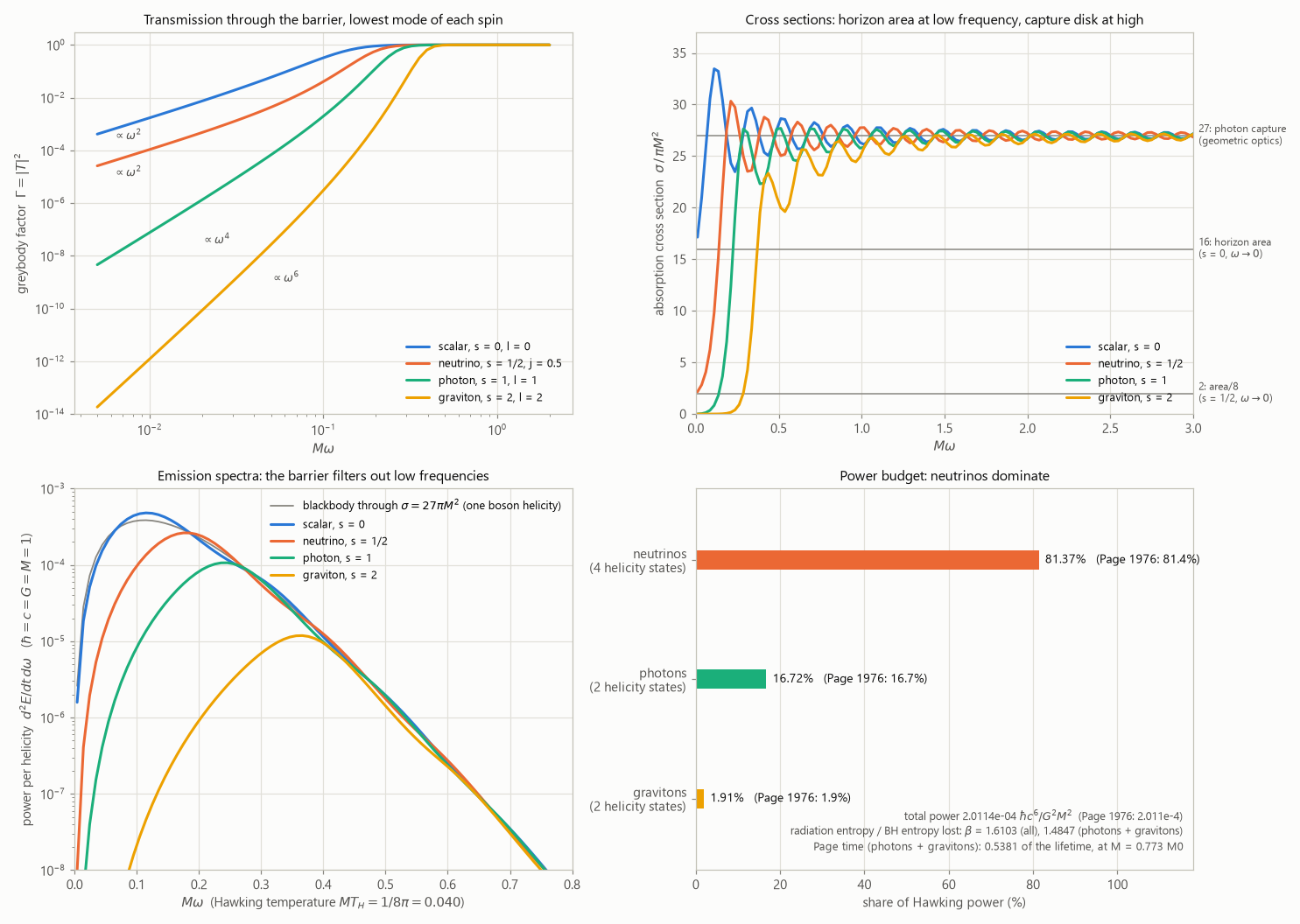
- Page’s budget for an evaporating black hole (1976, 2013) reproduced to every quoted digit: 81.4% of the energy leaves as neutrinos, and the Page time (when the radiation starts carrying information out) falls at 53.81% of the lifetime.verified · known
- Area laws reproduced; κ = 0.2954.verified · known
An analog horizon
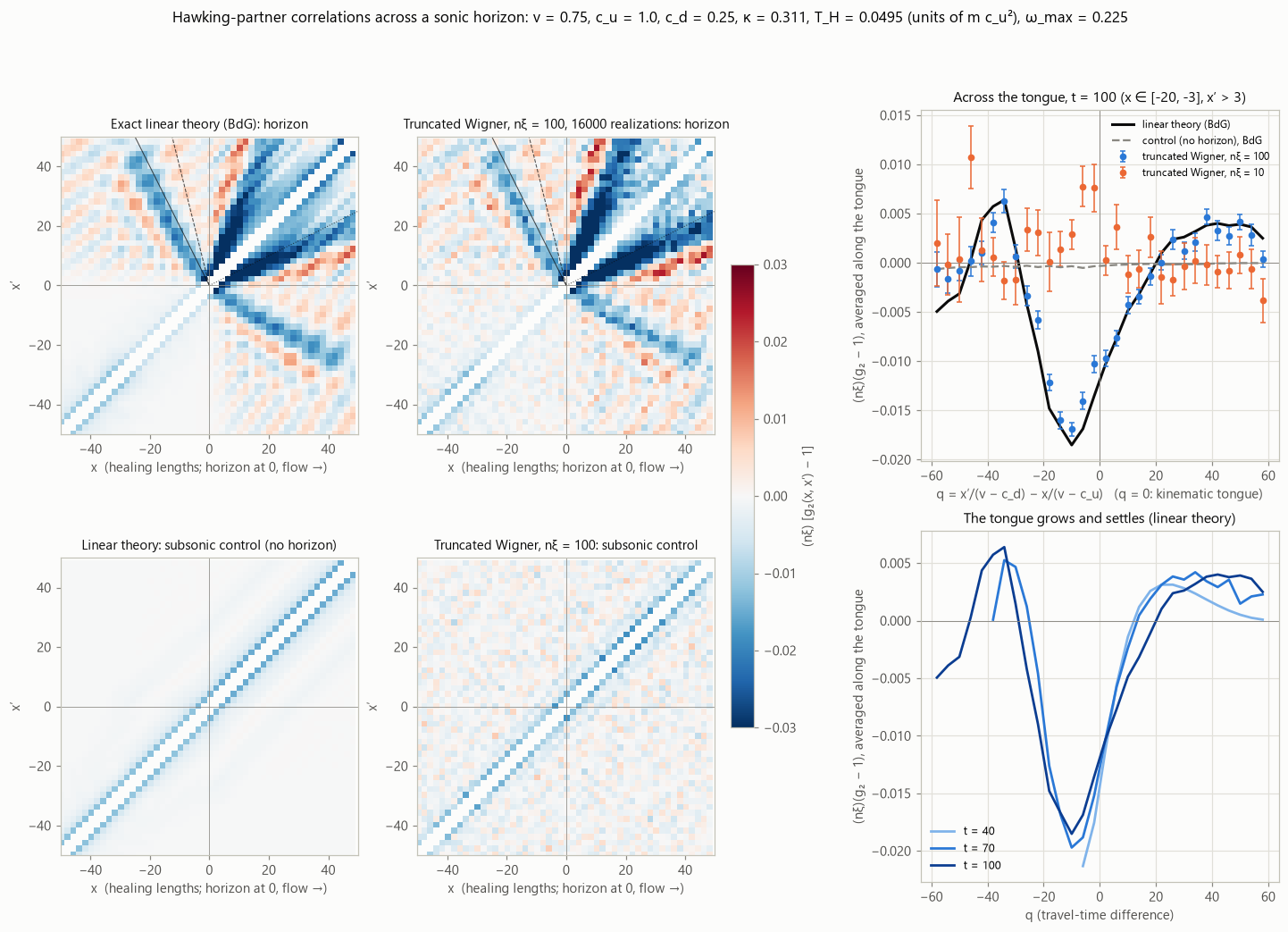
- In a Bose–Einstein condensate (a gas cooled until its atoms move as one quantum wave) flowing faster than its own speed of sound, a sonic horizon forms. The correlation between Hawking partners appears in two independent methods, and the spectrum is thermal at κ/2π within 0.44%. The greybody factor at zero frequency, Γ(0), is known.verified · known
Islands
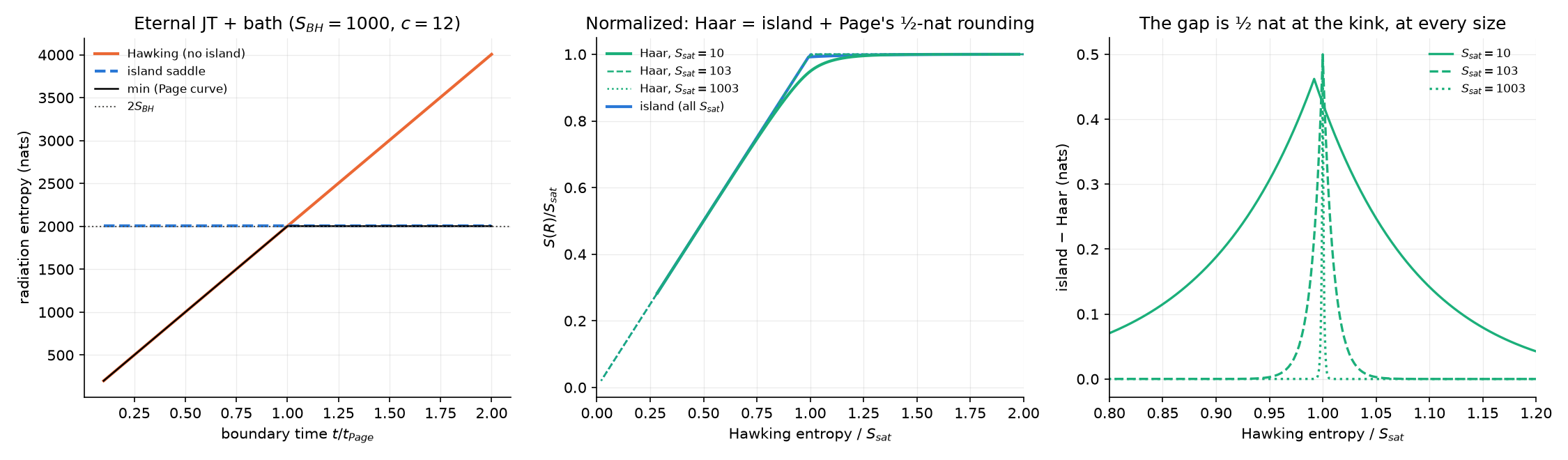
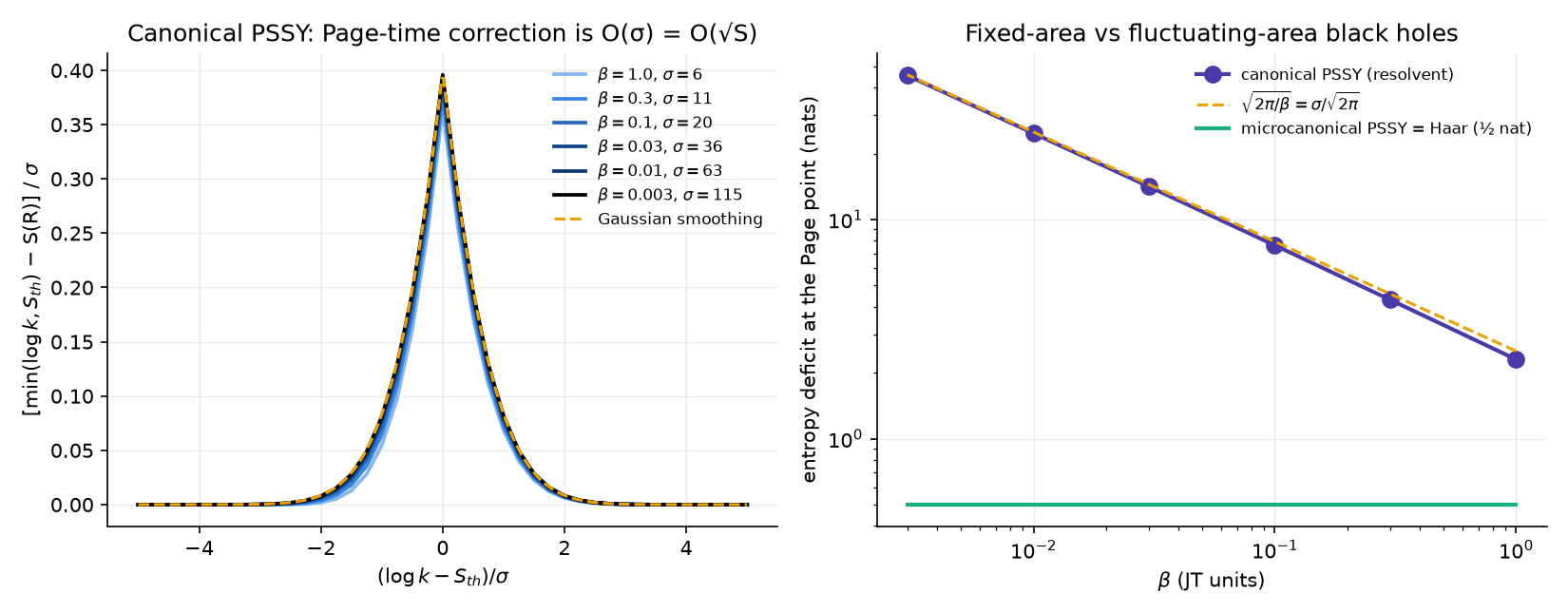
- Evaporation modelled with Haar-random unitaries (perfectly scrambling random evolutions) equals the fixed-area replica sum, and the island formula (the recent account of how information escapes an evaporating black hole) is its saddle-point limit. The island results reproduce AMM 2019 and PSSY to about 1e-11.verified · known
- The lab’s part is an error table for the Haar model: the greybody normalisation is 19.5% of S₀; area fluctuations of half a nat against √(2π/β); a missing scrambling delay. Hawking’s original entropy count is excluded after the Page time.ours
Lab records: H-0013; ledger/notes t3, t4, t7, t5-islands; understanding/09.
Tags: confidence (proved, verified, observed, suggestive, pending) and novelty (known, narrow, ours), defined on the overview.