Auditing collectives of AI agents: the framework and the tools
When many AI agents work together, an auditor sees some of what passes between them and none of what they hold inside. The lab brings over tools that black-hole physics built for the same situation.
Complementarity
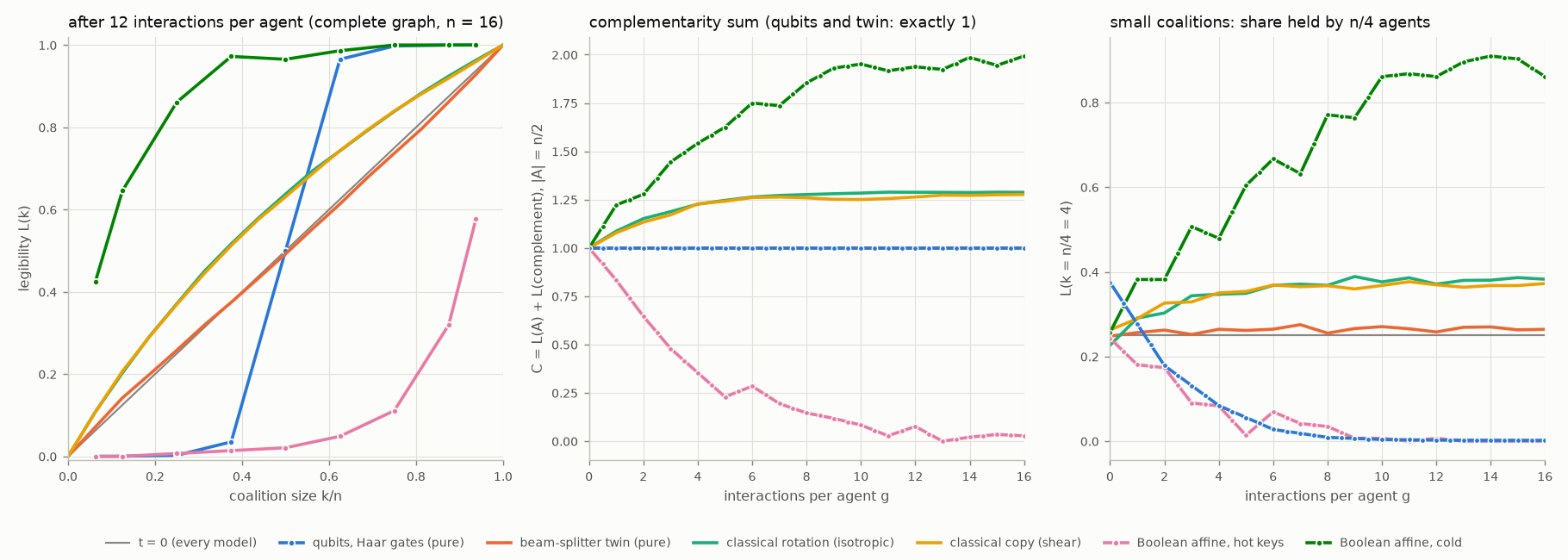
- For a closed collective, L(A) + L(Ā) = 1: what a coalition A can read and what everyone outside it can read add to the whole. The mathematics is known.proved · known
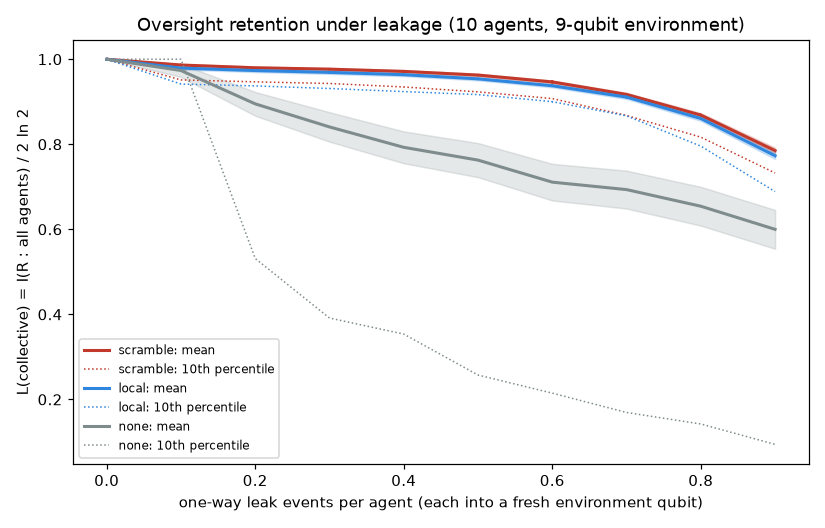
- Corrected: purity fixes only the midpoint of the curve that runs over coalition sizes; scrambling (mixing information across the whole collective) is what makes the curve step. The deficit can act as a key, and only L(all) measures leakage.
An auditor with the wrong model
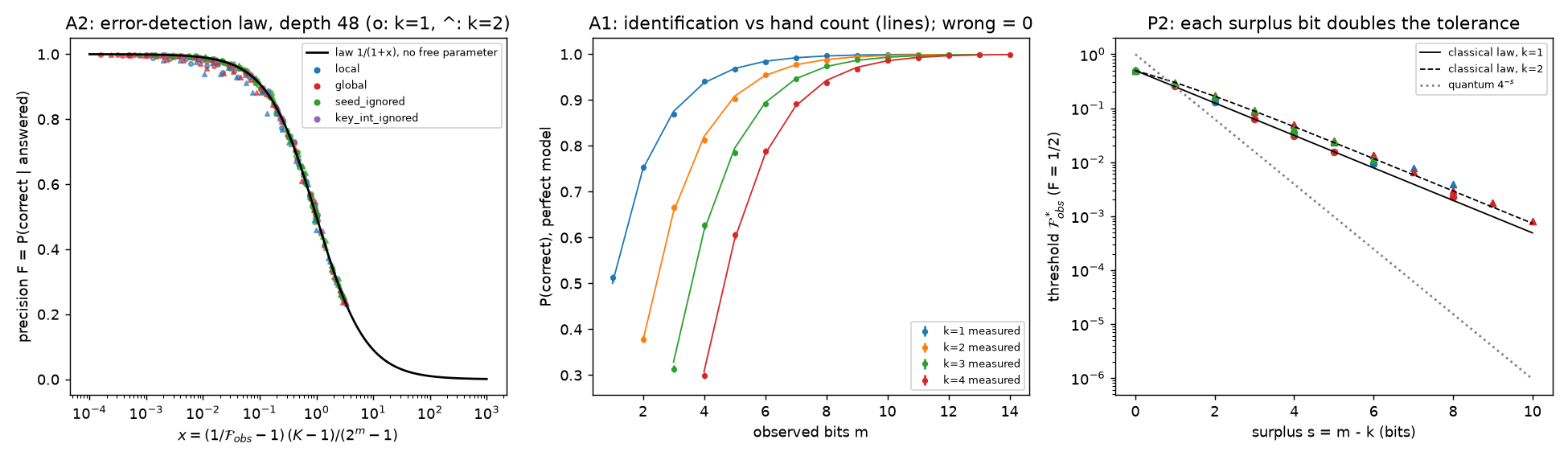
- An auditor that verifies against its model of the system abstains rather than errs when that model is wrong. Verified in toy systems and partly on quantum hardware. The closed forms are in Yoshida and Yao (2019).verified · narrow
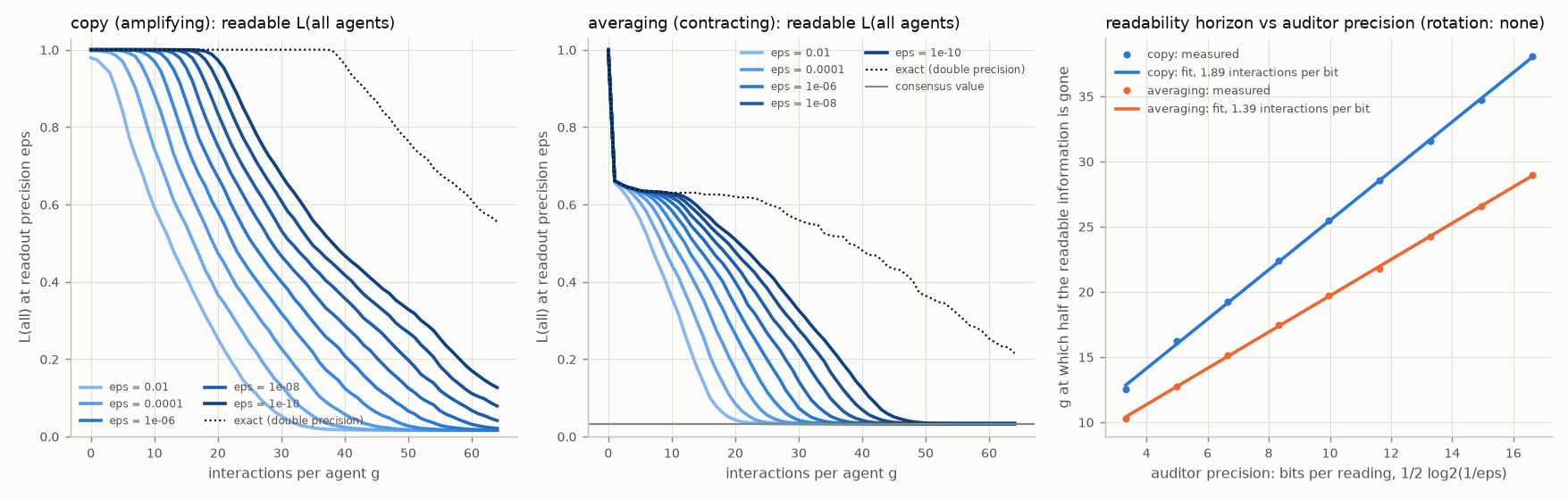
- The odds at threshold are (d_A² − 1)/(d_A² + d_D² − 1): about 4 times per extra logged qubit asymptotically, with the first qubit buying about 2 times. In the classical case, about 2 times per logged bit.verified · narrow
- Errors on the input side cannot be detected this way.verified · narrow
- Dynamics that collapse the state spend the redundancy, so the effective rank, not the nominal size, is what counts.verified · narrow
Containment ceilings from message metadata
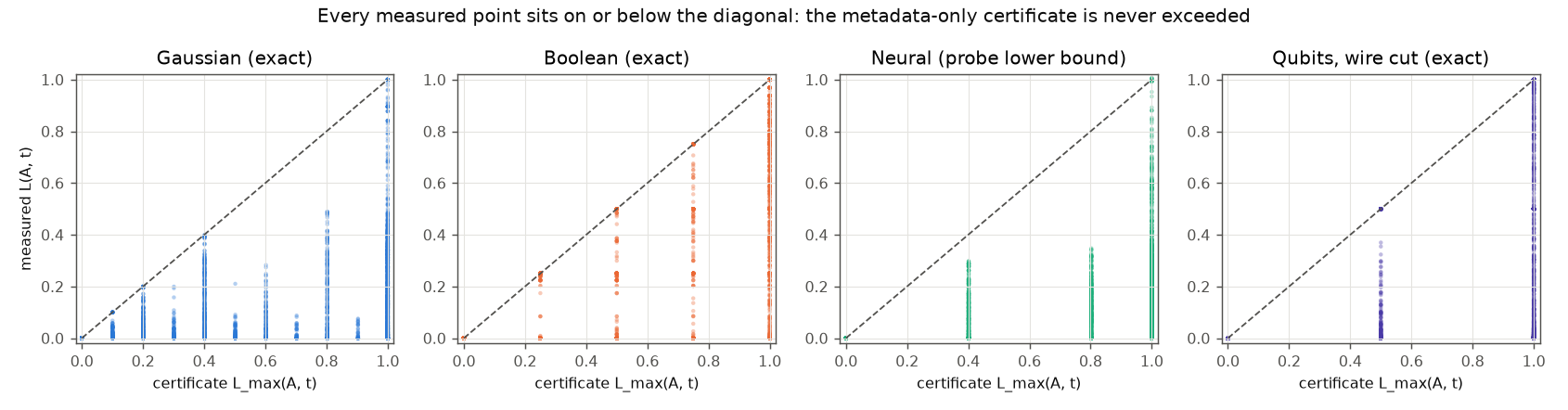
- A min-cut ceiling on who could possibly know a secret X, computed from metadata alone (who sent how much to whom). It is sound when the private randomness each agent uses is jointly independent of the secret. It is tight at the information front, and optimal coders reach it. Checked at 279,000 exact points.verified · narrow
- A replay auditor: log every input and random seed, then replay each hypothesis about what happened. Seed-committed replay against steganography (hidden messages in innocent-looking text) is known; the lab’s application is narrow.verified · narrow
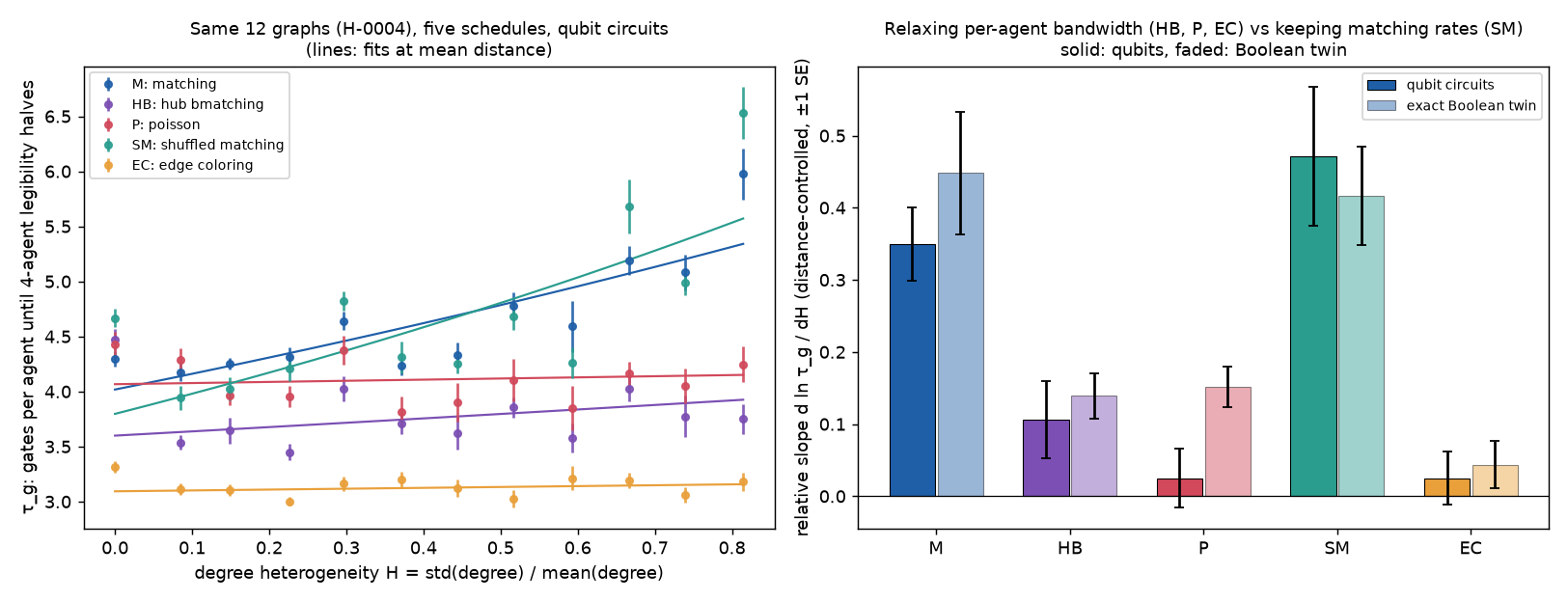
- Under per-agent bandwidth caps, how rates are allocated, not the network’s shape, slows the spread of information (z = −7.25). Earlier advice to insert repeats is withdrawn.verified
What the tools add up to
- Monitoring the content of messages cannot certify that no covert channel exists. Structural audits can bound covert channels: logged randomness, capacity ceilings, coalition structure and redundancy.suggestive
Lab records: H-0005, H-0010, H-0011; understanding/04 to 07; knowledge/oversight-mapping.md.
Tags: confidence (proved, verified, observed, suggestive, pending) and novelty (known, narrow, ours), defined on the overview.