Photon rings and the energy condition
Light can orbit a black hole. Each orbit in the photon ring is unstable, and the Lyapunov exponent γ (gamma: how fast a slightly perturbed orbit runs away) sets how much thinner each successive sub-ring in an image is: each is e^γ times thinner than the last.
The bound
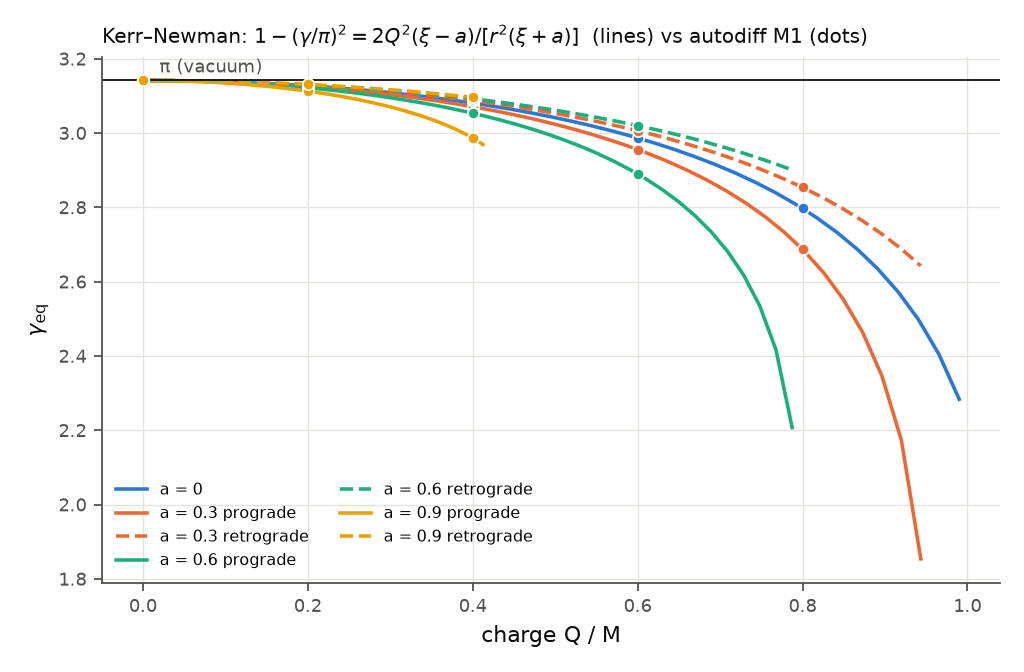
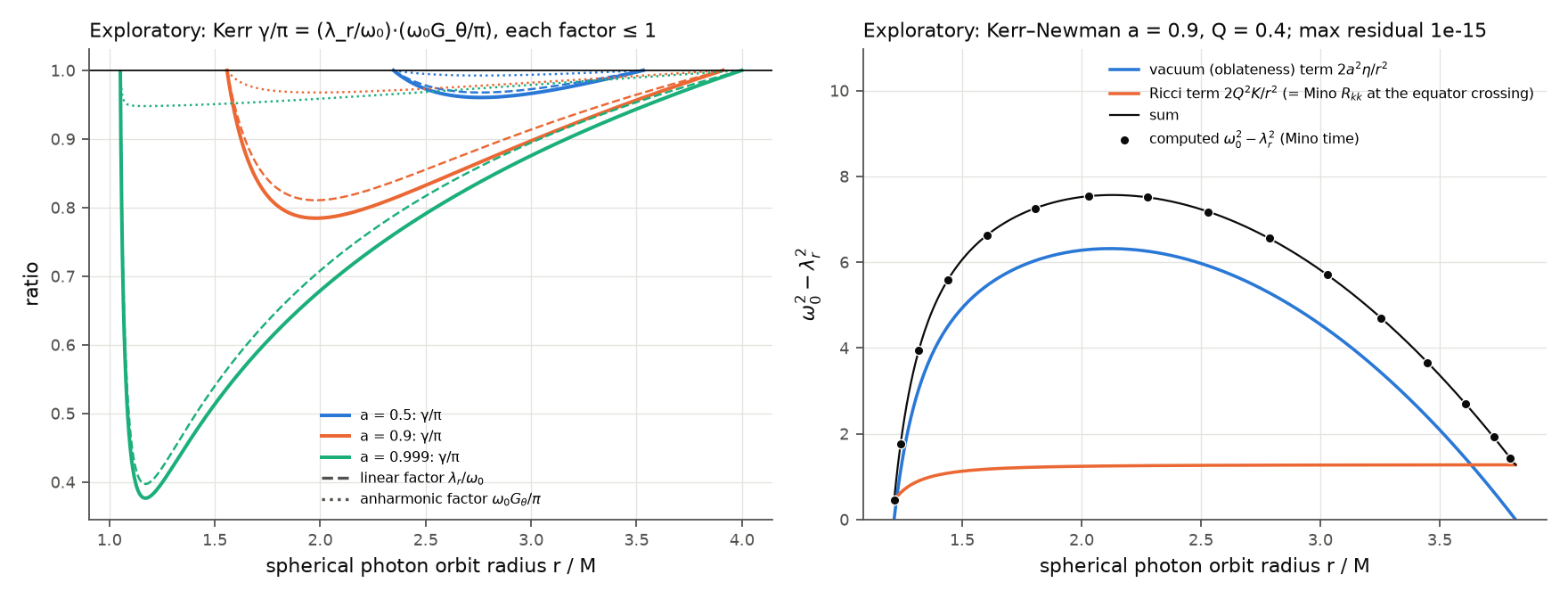
- γ ≤ π on every spherical photon orbit of a Kerr–Newman black hole (one that rotates and carries charge). The proof combines a polar oscillator that stiffens along the orbit, whose half-period is at most π/ω₀, with an exact identity, ω₀² − λ_r² = 2(a²η + Q²K)/r² ≥ 0, re-derived symbolically with residual 0. The static case was published by others; the rotating case is the lab’s.proved · ours
- The bound extends to a positive cosmological constant (Kerr–Newman–de Sitter).proved
- For a negative cosmological constant it is supported numerically only: no counterexample in 11,138 orbits. An earlier claim that the proof extends there was withdrawn.suggestive
An identity for the equatorial ring
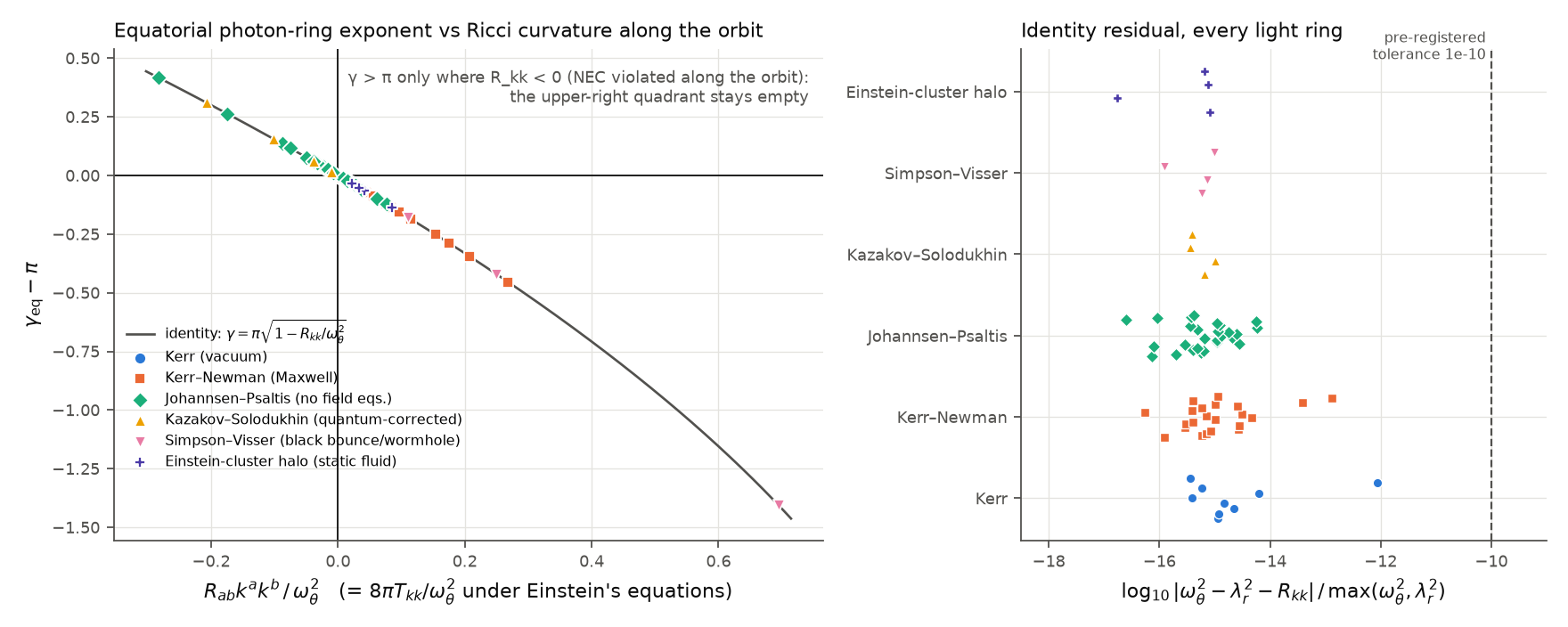
- 1 − (γ_eq/π)² = R_kk/ω_θ² for spacetimes that are stationary, reflection-symmetric and circular, where R_kk is the curvature along the light ray and ω_θ the vertical oscillation frequency of the orbit. Proved symbolically for a general metric and checked at 70 light rings in 6 families of spacetimes to 8.8e-13. The epicyclic form is known (Delgado 2022), and so is the reading for static spacetimes through the null energy condition (Igata 2025; Walia et al. 2026). The general form normalised by the polar frequency is the lab’s.proved · narrow
- Reading: under Einstein’s equations, an equatorial γ above π would mean negative energy along the ring (a violation of the null energy condition, which says energy measured along a light ray is never negative), or gravity beyond Einstein’s.
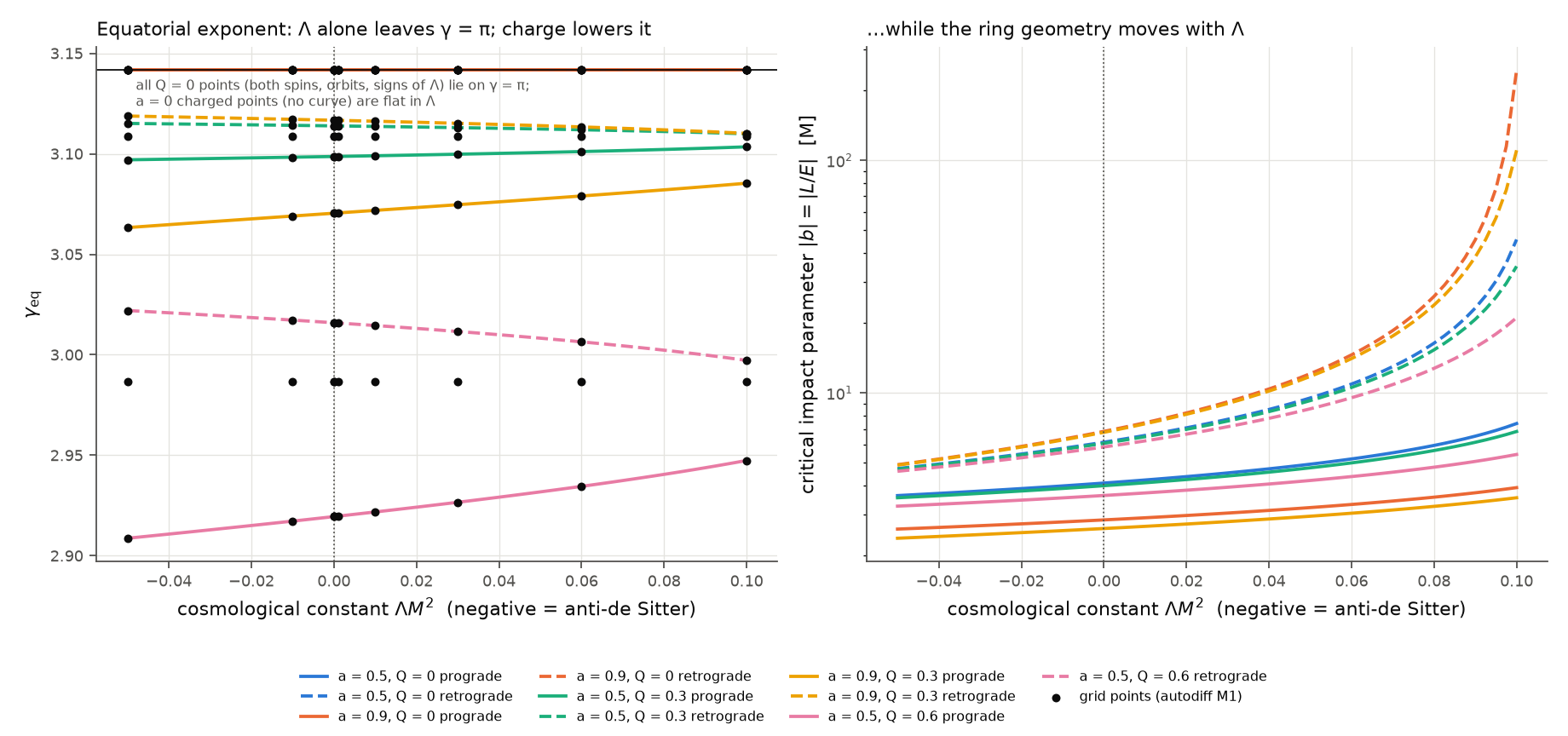
- The cosmological constant Λ cannot change γ_eq, because Λ g_kk = 0 for any light ray. The numbers were known (Omwoyo 2022); the reason and the closed form for charged black holes are the lab’s.narrow
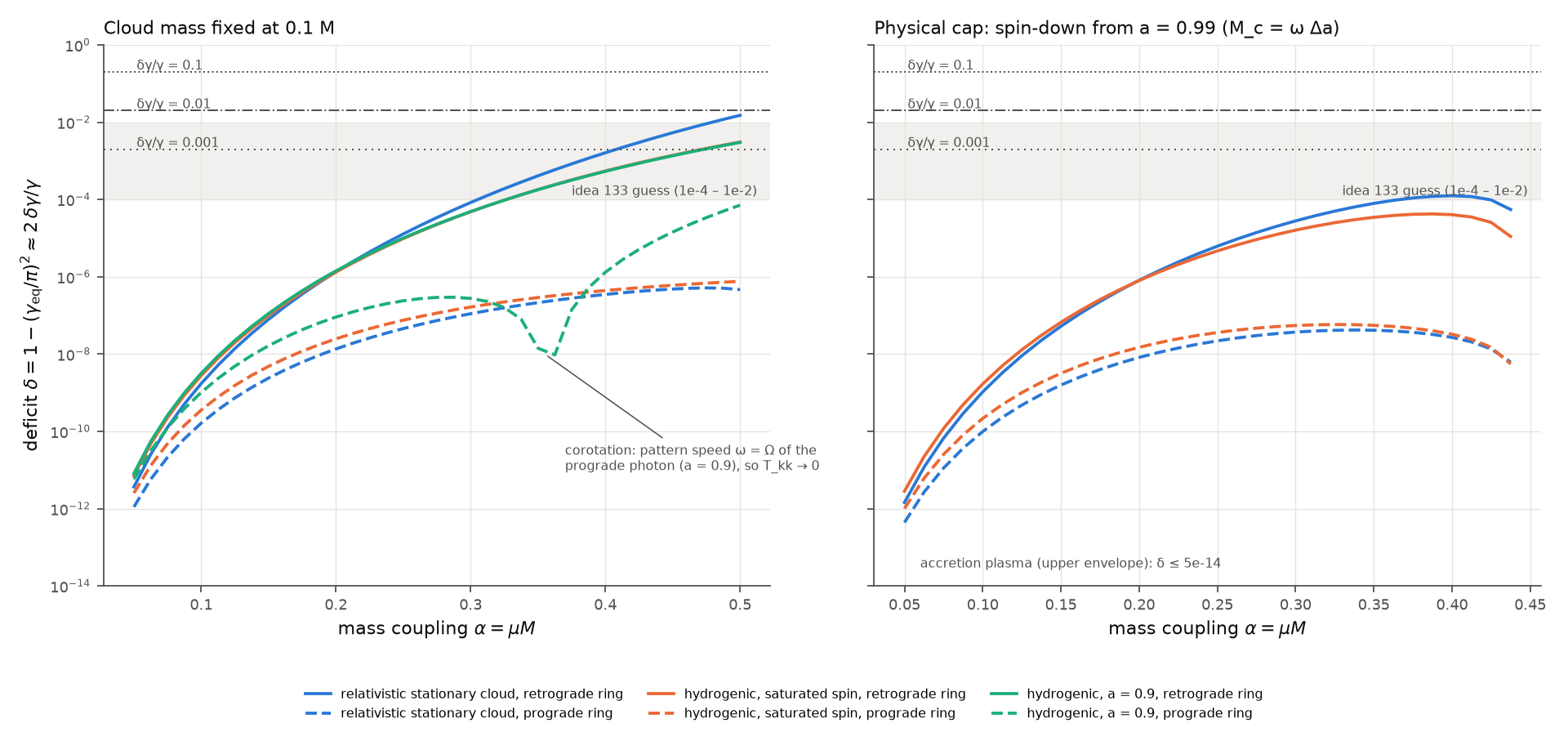
- Boson clouds (hypothetical halos of light dark-matter particles around a black hole) shift γ_eq by at most 1.25e-4, below any planned measurement precision. The pre-registered prediction was below 1e-4, and that clause failed.observed
Corrections and limits
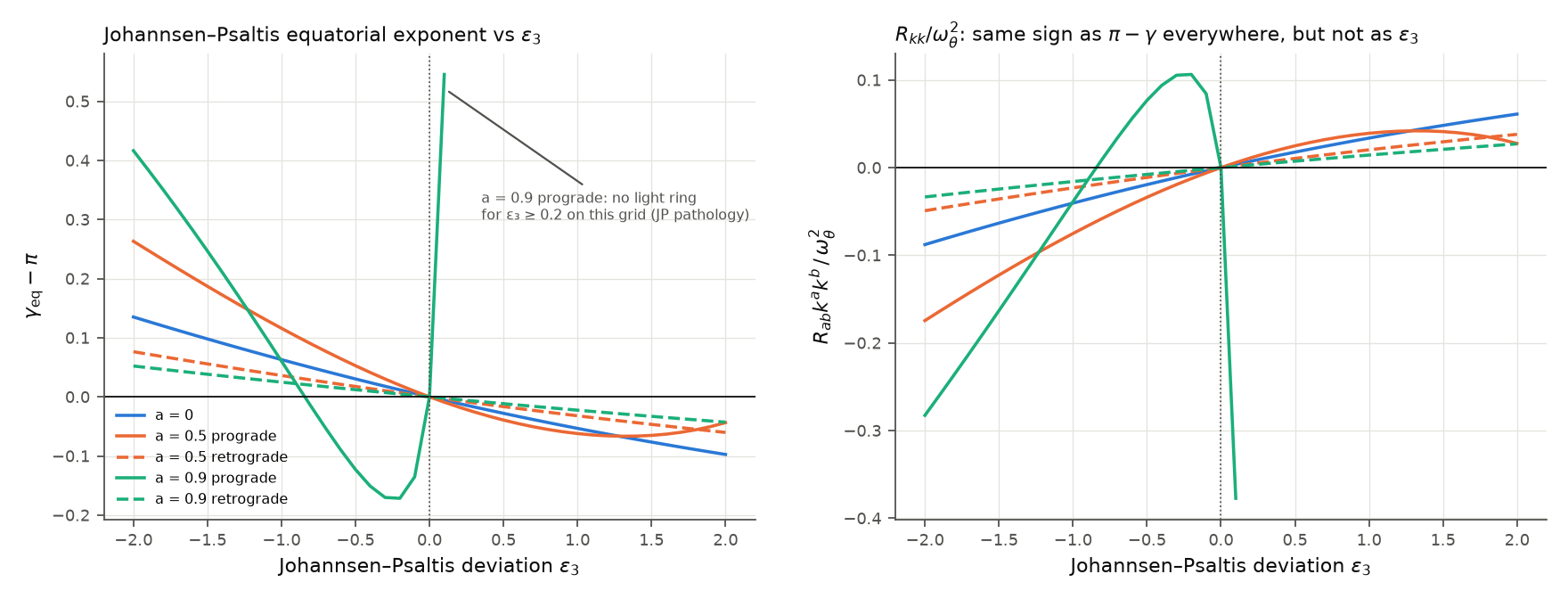
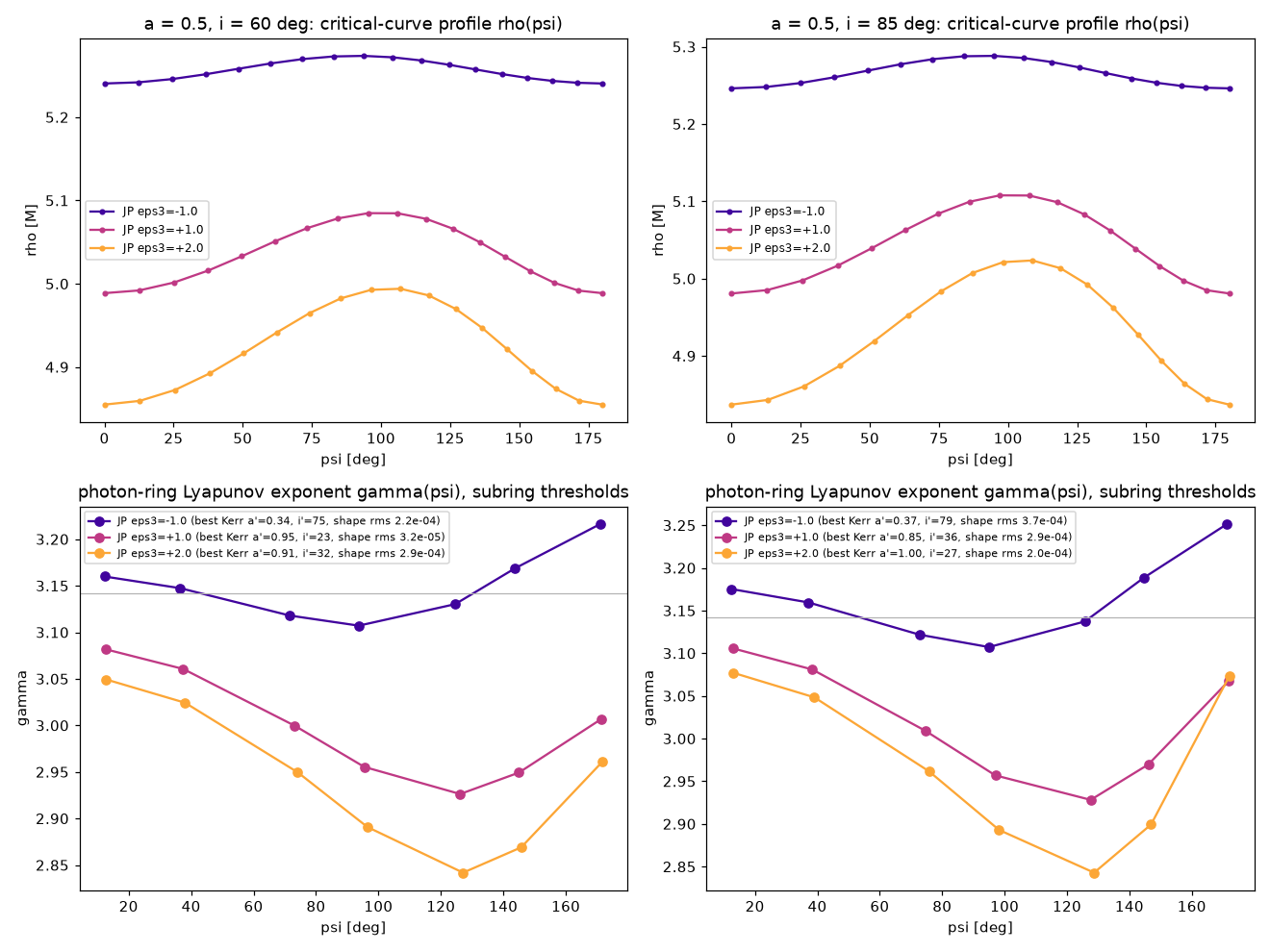
- Corrected (H-0002): a negative Johannsen–Psaltis deviation (a standard way of bending the Kerr metric to test it) raises γ only at low spin. At spin a = 0.9 the sign flips.
- Outside the theorem: sources from nonlinear electrodynamics, and metrics that are not circular.
- Astrophysical plasma is 12 to 14 orders of magnitude too thin to matter for these rings.
Lab records: H-0002, H-0008, H-0015; ledger/understanding/01 and 02.
Tags: confidence (proved, verified, observed, suggestive, pending) and novelty (known, narrow, ours), defined on the overview.